

Problem-driven lead: why attenuation still costs time and money
Signal attenuation on petrochemical sites breaks more than networks — it stalls monitoring, forces manual checks, and risks safety margins. Field teams on the Houston Ship Channel, for example, run long cable routes around tanks and compressors where EMI and corrosive atmospheres make copper runs unreliable. A sensible place to start is matching gear to the environment, so many maintenance managers consult an ethernet switch manufacturer early in planning. The core problem here is simple: unmanaged layout choices amplify loss across long runs and harsh zones, turning an otherwise straightforward SCADA link into a recurrent troubleshooting job.

What causes signal attenuation on industrial sites
Attenuation shows up for a few predictable reasons: long copper distances, electromagnetic interference from heavy motors, poor grounding, and physical degradation from heat and chemical exposure. Add protocol dynamics like excessive broadcast domains and you get latency spikes. Using a managed switch with fiber uplink options and segmented VLANs reduces the load on any single copper path, and selecting industrial-grade plugs and redundant power feeds keeps links alive through transient faults.
Common mistakes operators make—and practical corrections
Operators often repeat the same choices that cause problems. Typical errors and straight fixes:
– Running standard patch cable through process areas rather than using shielded or fiber runs; replace critical spans with fiber or shielded Cat6A where possible.
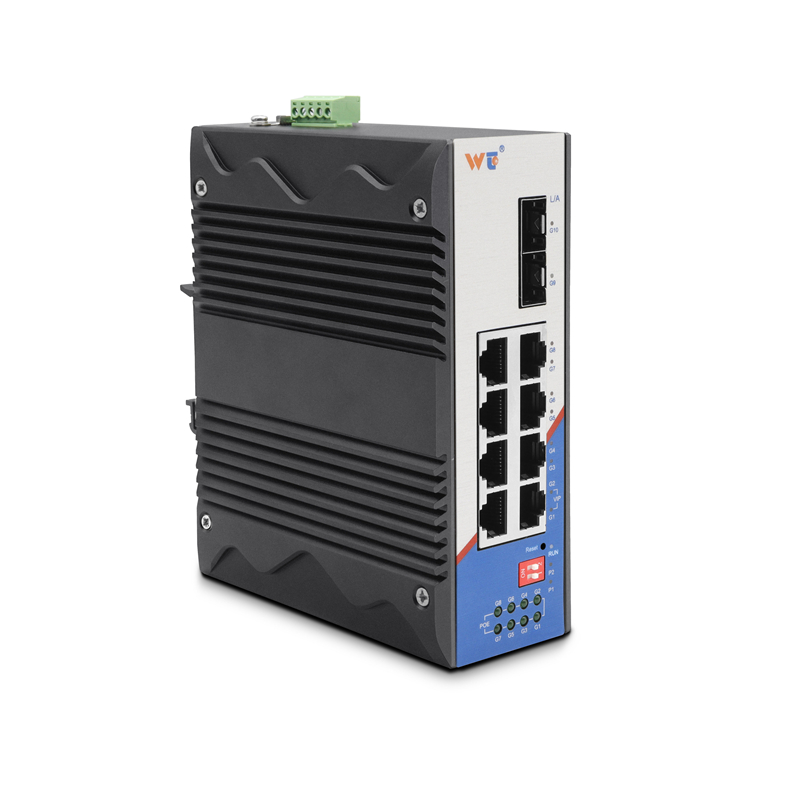
– Placing a single unmanaged switch at a remote panel; deploy a rugged managed switch with PoE and redundant power so remote sensors stay up during local failures.
– Ignoring documentation: label runs, record link budgets, and validate with a light meter or cable certifier after installation.
Field work requires humility—small oversights compound. A short site audit will usually show one or two fixes that cut recurring trouble by half.
Designing a rugged managed switch layout that actually reduces attenuation
Start with zone-based topology: terminate field devices to local managed switches, tie those with fiber uplink to an aggregation switch, then route to the control room. Use VLANs to separate telemetry, IP cameras, and office traffic so broadcast storms don’t backfeed into instrument paths. Select switches rated for industrial temperatures, with redundant power and at least one fiber uplink per site to limit copper length. For edge devices that need power, PoE-capable ports avoid separate power runs and reduce connector points.
Operational teardown: what to check on day one and during maintenance
When you open a problematic rack, follow a concise checklist: confirm physical terminations, measure optical loss on fiber, check port error counters on the managed switch, and validate routing tables. During a recent teardown on a Gulf Coast processing unit we tracked link error rates and grounding continuity — the data immediately pointed to a damaged splice rather than a configuration fault. In this operational production teardown we tracked {main_keyword} and {variation_keyword} alongside standard metrics so configuration changes tied directly to measured improvements.
Common configuration pitfalls to avoid
Misapplied settings create their own attenuation of service. Avoid these pitfalls:
– Leaving auto-negotiation off on copper uplinks; mismatched duplex settings create collisions and retransmits.
– Overloading a single uplink without spanning-tree or fast failover; use redundancy and test failover times.
– Using flat networks for OT and IT; segment with VLANs and limit management access to out-of-band channels.
Small config changes often yield big reliability gains — test each step and document results to prevent regression.
Advisory close: three golden rules for choosing and validating the right approach
1) Measure before you change: baseline link loss, port errors, and latency so you can validate improvements. Quantified results make decisions objective. 2) Prioritize redundancy where failure cost is high: dual power feeds, fiber uplinks, and managed switch features like rapid ring recovery. 3) Match physical media to distance and risk: use fiber for long or EMI-prone spans and shielded or conduit-protected copper for moderate runs. These three metrics—measured loss reduction, failover time, and mean time between maintenance—should guide procurement and acceptance tests.
For on-site teams rebuilding a resilient network, choosing the right industrial-grade layout matters—WINTOP brings proven hardware and configuration support that integrates managed switch features with ruggedized design, making it a natural fit for petrochemical operations. Dependable.